Poisoned at the Root: The Hidden Danger of Trusting Your Dependency Tree
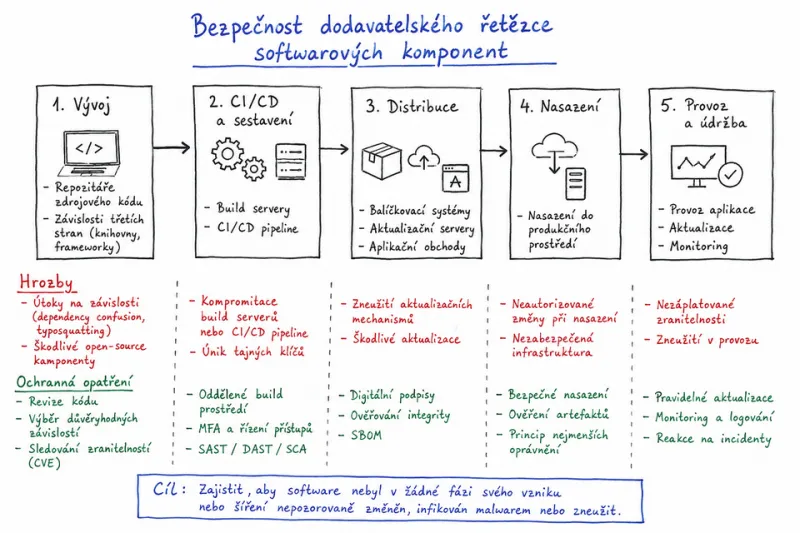
Photo: Autor: ChatGPT (OpenAI), Public domain, via Wikimedia Commons
Every time a developer runs npm install or pip install, they are extending institutional trust to code they almost certainly have never read. That trust, multiplied across thousands of packages and millions of applications, has become one of the most exploited attack surfaces in modern software engineering. The consequences are not theoretical. They are measured in breached user records, exposed credentials, and regulatory fines—costs absorbed quietly by organizations that often never disclose what went wrong.
WhistleDev has spent the past several months reviewing documented supply chain incidents, speaking with security engineers who requested anonymity, and analyzing public vulnerability disclosures. What emerged is a portrait of an ecosystem in which negligence and malice have become nearly indistinguishable—and in which individual developers are routinely left holding the bag.
The Architecture of Invisible Risk
Consider the average Node.js application. A single top-level dependency may pull in dozens of transitive dependencies—packages that the developer never explicitly chose and may never examine. Research published by Sonatype in its annual State of the Software Supply Chain report consistently finds that the majority of vulnerabilities in modern applications originate not in direct dependencies, but in these second- and third-degree relationships buried deep in the dependency graph.
The 2021 compromise of the widely used ua-parser-js npm package illustrates this dynamic with uncomfortable clarity. An attacker gained access to the maintainer's npm account and published three malicious versions of the package in rapid succession. Those versions contained scripts that installed a cryptominer on Linux systems and a password-stealing trojan on Windows. Because ua-parser-js had tens of millions of weekly downloads and was embedded in products from Facebook, Microsoft, and Amazon, the blast radius was immediate and severe. The developer who originally authored the package had no idea anything had happened until users began filing issues.
This is not an isolated incident. The event-stream attack in 2018, the colors and faker sabotage in 2022, and the xz-utils backdoor discovered in 2024—each of these events revealed a different failure mode within the same fundamental problem: the open-source ecosystem was never designed with adversarial supply chains in mind.
Negligence Is Not Malice—But the Damage Is the Same
Not every compromised dependency involves a bad actor. Many of the most dangerous packages in production today are simply abandoned. Maintainers move on, lose interest, or burn out under the weight of unpaid labor. Security patches go unwritten. Known vulnerabilities accumulate in the National Vulnerability Database while downstream consumers remain blissfully unaware.
The Log4Shell vulnerability—disclosed in December 2021 and affecting the ubiquitous Apache Log4j library—demonstrated what happens when a foundational component goes unpatched across an industry. Attackers exploited the flaw within hours of public disclosure. The U.S. Cybersecurity and Infrastructure Security Agency (CISA) estimated that hundreds of millions of devices were potentially vulnerable. Many organizations discovered they were running Log4j only after they began scanning in response to the emergency advisory.
The uncomfortable truth is that engineering teams at well-funded companies were running software they did not fully understand, maintained by volunteers who received no compensation for the burden of securing critical infrastructure. That is not a failing of individual developers. It is a structural problem—and it demands a structural response.
Auditing the Dependency Tree: A Practical Framework
The first step toward supply chain hygiene is visibility. Developers cannot protect what they cannot see. Several mature tooling options now exist for generating and maintaining a Software Bill of Materials (SBOM), a machine-readable inventory of every component in an application.
Tools worth integrating into your pipeline include:
- Syft and CycloneDX for SBOM generation across multiple ecosystems
- Grype and OSV-Scanner for vulnerability scanning against current CVE databases
- Dependabot and Renovate for automated dependency update pull requests
- Socket.dev for behavioral analysis of npm packages, flagging unusual network calls or file system access in new versions
Beyond tooling, teams should establish a formal dependency review process. Before any new package is added to a project, engineers should evaluate: the package's maintenance history, the number of active contributors, whether the maintainer account uses two-factor authentication, and whether the package has a published security policy. This is not bureaucracy for its own sake. It is the same due diligence applied to any other third-party vendor relationship.
Version pinning—locking dependencies to specific, audited versions rather than accepting automatic minor or patch updates—provides an additional layer of control. It is not a complete defense, as demonstrated by the ua-parser-js incident, but it eliminates the class of attacks that rely on a developer passively accepting whatever the latest published version happens to contain.
Building a Culture That Takes Third-Party Code Seriously
Tooling alone will not solve this problem. The deeper issue is cultural. In many engineering organizations, adding a dependency is treated as a trivially low-cost decision. The npm ecosystem, in particular, has normalized a culture of micro-packages—single-function libraries that fragment logic across dozens of external repositories. The infamous left-pad incident of 2016, in which the unpublishing of an 11-line package broke thousands of builds, was a warning that much of the industry chose to laugh off rather than internalize.
Senior engineers and engineering managers bear responsibility for modeling a different standard. Dependency decisions should be treated with the same review rigor as any other architectural choice. Pull requests that introduce new packages should require explicit justification. Teams should conduct periodic audits of their existing dependency inventories, removing packages that are no longer needed or that have been superseded by safer alternatives.
Organizations that take supply chain security seriously also invest in contributing back to the open-source projects they depend on—whether through financial sponsorship via platforms like GitHub Sponsors or Open Collective, or through direct engineering contributions. A maintainer who has adequate support is a more attentive maintainer. That is not altruism. It is risk management.
The Reporting Imperative
When developers discover that a dependency they have been shipping is compromised or negligently maintained, they face a decision that carries real professional risk. Raising the issue internally may be unwelcome. Disclosing it publicly may invite legal scrutiny. Saying nothing perpetuates the harm.
Responsible disclosure frameworks exist precisely for this scenario. CISA maintains a coordinated vulnerability disclosure process. Most major package registries, including npm and PyPI, have security reporting mechanisms. If an organization actively discourages reporting a known vulnerability in a dependency—particularly one that affects user data—that suppression may itself constitute an ethical violation worth documenting.
The supply chain is not someone else's problem. Every developer who ships code that touches user data is a node in that chain. The question is not whether your application has a dependency risk. It is whether you have chosen to look.